
Call Us: 800-207-2259


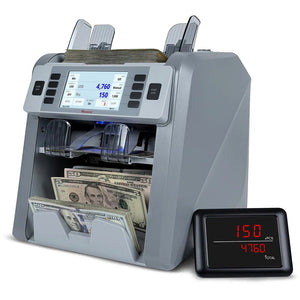
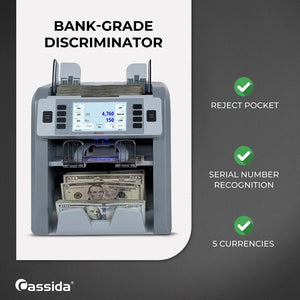

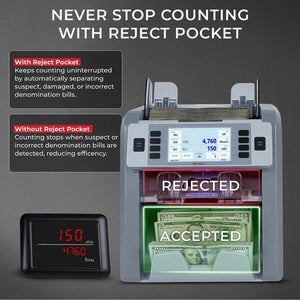

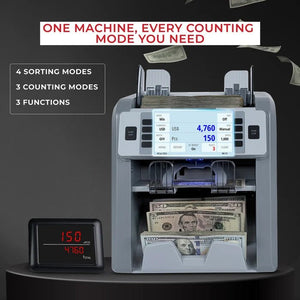
The Cassida CRS 9500 is a Bank-grade 2-pocket mixed bill counter, sorter, and reader built for high-throughput cash offices that cannot afford to stop the count every time the machine encounters a suspect bill. Where every other mixed bill counter in Cassida's CRS line halts on a counterfeit alert, denomination mismatch, or misfeed, the CRS 9500 automatically diverts the problem bill into a dedicated 80-note reject pocket and keeps counting. For bank branches, casino cash cages, high-volume retail cash offices, and currency exchange operations where counting speed and workflow continuity matter, the 2-pocket design is the single biggest workflow upgrade over the single-pocket CRS 7500 and CRS 8500.
The 80-note reject pocket is the headline feature. During a count, any bill that fails one of the counterfeit detection scans, cannot be read as a known denomination, or triggers a misfeed condition is routed to the reject pocket instead of stopping the operator mid-stack. At the end of the count, the operator pulls the rejected bills from the second pocket, inspects them individually (counterfeit, foreign currency, torn, or mis-oriented bills end up here), and reruns the ones that should pass through on a second attempt. The count on the main stacker is uninterrupted, which matters when you are processing a day's worth of deposits in one session, closing out ten registers at end of shift, or running a vault count under time pressure.
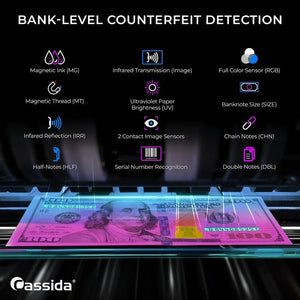
Counterfeit detection on the CRS 9500 pairs dual Contact Image Scanners (2CIS) with Cassida's three standard sensor types in parallel. The 2CIS component scans each bill as a full-field image from both sides, checking the printed artwork against reference patterns to catch counterfeits that pass the sensor-only tests. Ultraviolet (UV) sensors scan each bill for the UV-reactive fluorescent fibers embedded in genuine currency. Magnetic ink (MG) sensors scan for the magnetic signature of genuine currency ink. Infrared (IR) sensors check for the IR-based opacity patterns that distinguish real notes from counterfeits printed on ordinary paper. Any bill that fails one of these checks is diverted to the reject pocket for operator review.
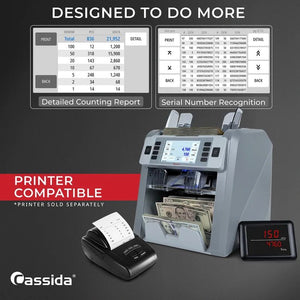
The CRS 9500 captures each bill’s serial number as it feeds via Serial Number Recognition (SNR), producing a per-bill log that supports chain-of-custody tracking, compliance reporting, and investigation of marked or stolen bills. For bank branches, casino cash cages, and cash exchange operations where bill-level audit trails matter, the SNR log plus the detailed denomination-breakdown counting report provides the audit documentation that compliance teams require.
Counterfeit detection on the CRS 9500 uses twelve parallel verification methods at bank-level depth. Dual Contact Image Scanners (2CIS) scan each bill as a full-field image from both sides, checking printed artwork against reference patterns. Ultraviolet (UV) sensors scan for the UV-reactive fluorescent fibers embedded in genuine currency. Magnetic ink (MG) sensors scan for the magnetic signature of genuine currency ink, and magnetic thread (MT) detection verifies the embedded security thread. Reflector and transmissive infrared (IRR) sensors check IR opacity and reflection patterns. A full-color RGB sensor checks color accuracy; dimensional verification (SIZE) confirms the physical size matches genuine banknote specifications; chain-note (CHN), half-note (HLF), and double-note (DBL) detection catches multi-bill feed errors; and Serial Number Recognition (SNR) captures each bill’s serial number. Any bill that fails one of these checks is diverted to the reject pocket for operator review
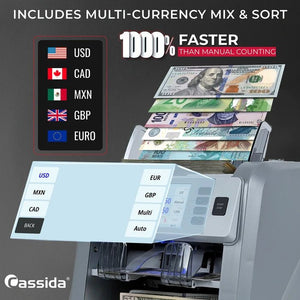
The CRS 9500 ships with multi-currency support for five currencies: U.S. dollar (USD), Canadian dollar (CAD), Mexican peso (MXN), euro (EUR), and British pound (GBP). The Auto-Currency mode automatically detects each bill's currency as it feeds through the hopper, which matters for currency exchange operations, border retail locations handling USD alongside MXN or CAD, and international cash offices.
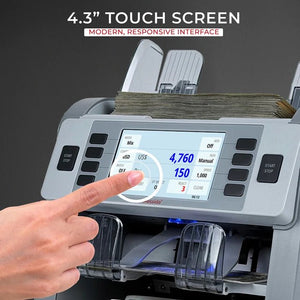
The 4.3-inch TFT color touch screen on the operator side lets operators navigate the mode library, mode-specific settings, currency selection, batch size entry, and counterfeit alerts via direct touch rather than button navigation. The included external customer-facing display sits on the customer side of the counter and shows the running count and total in red LED. For back-office installations with no customer-facing requirement, you can set aside the external display.
The CRS 9500 includes a USB port, an RJ11 port, and an RS-232F port for connecting to a POS system, cash management software, or the optional Cassida Cash Handling Printer (sold separately). The USB port supports data export (counting reports to a flash drive) and connection to a POS computer; the RJ11 port provides a modem-style serial connection; and the RS-232F port drives external printers and legacy POS integrations.
At 20 pounds and 11.2 inches wide by 11.2 inches deep by 11.7 inches tall, the CRS 9500 is heavier and slightly larger than the single-pocket CRS 8500 (13.6 lbs, 9.6W x 10.8D x 11.3H) to accommodate the second pocket's bill-routing mechanism and the diverter hardware that routes suspect bills to the reject pocket. The 2-pocket chassis fits on a standard retail counter or back-office table.
The CRS 9500 is designed, engineered, and inspected in the USA, and ships with Cassida's 3-year product warranty plus free lifetime professional support, so a question about calibration, a sensor issue, or a feed gap adjustment down the road gets you a phone call from Cassida's California-based support team.
If you don't need the 2-pocket reject feature and a single-pocket Professional-grade counter will do, the Cassida CRS 8500 offers the same 2CIS counterfeit detection, same touch screen, and the same 5-currency support in a single-pocket chassis at a lower price point. If you need multi-currency breadth over the Bank-grade reject pocket, the Cassida 8800R V2 supports 10 currencies (vs. the CRS 9500's 5) in a single-pocket chassis with the same 2CIS detection and touch screen. If your cash workflow is business-grade and USD-focused and you do not need image-based counterfeit detection, the Cassida CRS 7500 is a lower-priced single-pocket top-loader at the same 1,200 bills per minute throughput.
If you have questions about the CRS 9500, whether the 2-pocket reject design fits your cash workflow, or how it compares to the CRS 8500 or 8800R V2, please call us at 800-207-2259.
Features:
Specifications:
Industry Use:
Warranty: